
How to compare contractor bids for a house rehab
Two contractors walk the same kitchen. One quotes $18,400, the other $20,100. Which number goes into your offer worksheet? In this fictional example, the answer turns on who pays for the counters you chose and who hauls away the old ones.
Give both contractors the same kitchen to price
Suppose you plan to keep the cabinets and floor plan, replace the counters and sink, repaint the walls, and remove the debris. Send each contractor the same measurements, finish selections and photos. Ask them to flag anything they need to measure in person. If one contractor prices a layout change or a different finish, keep that option on its own line.
A written scope can be short. For the counters, specify the material, measured area, edge detail and sink cutout. Ask who will supply, deliver and install them. For demolition, ask who disconnects and reconnects the sink and who pays for disposal. Those answers give you something concrete to compare when both bids say “kitchen renovation.”
Put both bids on the same footing
Here, Bid A includes a $1,800 allowance for countertop materials. An allowance is money already included for an item whose final cost is still open. The selected material costs $3,000 on the same delivered basis. Installation is already covered in both bids. Bid A also excludes disposal, for which you have a separate $800 written quote. Bid B includes both the selected material and disposal. Assume the remaining work, taxes and fees match.
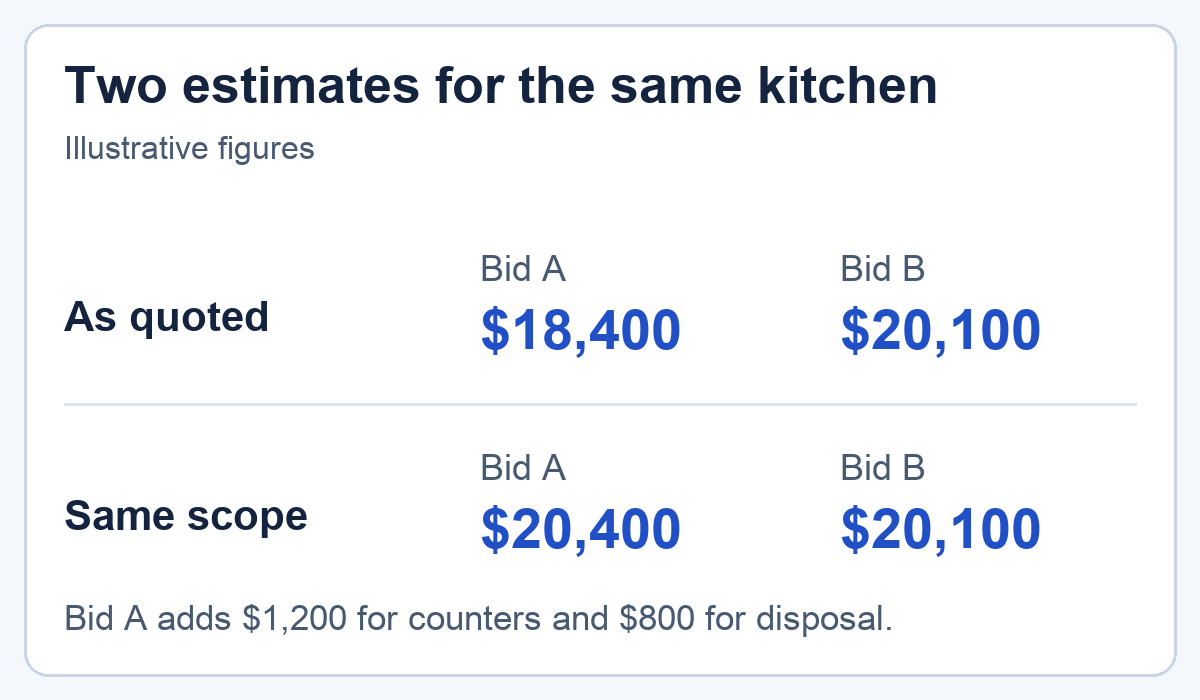
Bid A comes to $20,400. Start with $18,400, add the $1,200 difference between the material price and the allowance, then add $800 for disposal. Adding the entire $3,000 would count the first $1,800 twice.
Bid B stays at $20,100. The bid that first looked $1,700 more expensive is now $300 cheaper for the specified work. If you have yet to price disposal, keep that line open. At $500 for disposal the bids tie. Above $500, Bid B costs less under these assumptions. That tells you exactly which phone call to make before relying on the lower number.
Keep unknown repairs visible
Suppose the walkthrough also turns up a soft spot under the sink. Neither contractor has opened the cabinet base to inspect the subfloor. Give that issue a separate line in your budget with an owner and a next step. Ask what inspection would resolve it, who can authorize access and how a repair would be priced. A blank line can look like a zero to the next person reading the sheet.
Keep a copy of each original bid alongside your comparison. For every adjustment, write down the item, the amount already included, the added cost and the quote date. If a contractor confirms a change by phone, ask for a revised written estimate. You can then see which figures came from a contractor and which still depend on your assumptions.
Decide which number belongs in the offer
In this example, use $20,100 as the price of the defined kitchen work if Bid B confirms the scope and timing in writing. Carry the subfloor question separately. If the deal only works when that repair costs zero, resolve it before treating the offer budget as settled. Check that the finishes you priced also match the renovated homes you used to estimate resale value. Compare closed sales for your after-repair value estimate.
The Federal Trade Commission recommends asking several contractors for written estimates that specify materials, work, timing and price. Oregon’s Construction Contractors Board also advises owners to identify allowances and record changes in writing. FTC guidance on hiring contractors · Oregon Construction Contractors Board guidance.
Apply this to your next seller lead
When you review a lead, separate what the seller reported from what a contractor has inspected. Pick one item that could change your budget and write the question you want answered on the walkthrough. Open a sample seller lead and practice spotting the first item to verify.